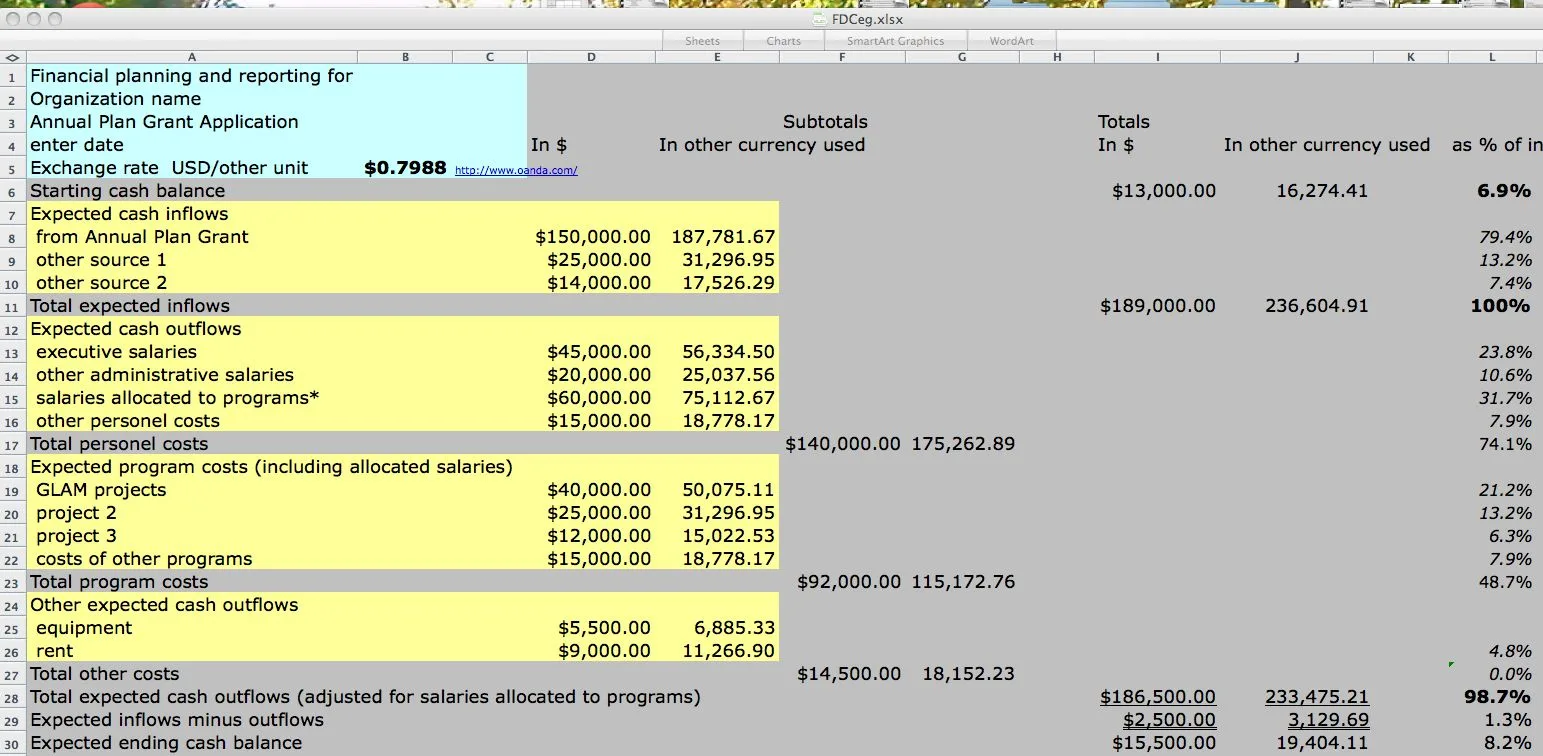
The short answer: Burn rate and runway are two numbers from one division problem. Net burn is monthly cash out minus cash in; runway is cash on hand divided by net burn. A company with $1,470,000 in cash burning $122,500 a month has exactly 12 months of runway.
- Track net burn, not gross burn, for the runway math — collections offset spend, and only the net figure sets the countdown.
- Runway = cash on hand ÷ net burn. Recompute it every close, because both inputs move monthly.
- Two levers extend runway: cut net burn or pull cash forward from receivables. On the worked file below they add 2.4 months without a headcount cut.
- The stakes are real: 34.7% of U.S. private-sector establishments born in March 2013 were still operating a decade later, per the Bureau of Labor Statistics.
Last updated September 2026.
Burn rate and runway answer one question a founder asks every month: how long until the cash runs out. Runway is cash on hand divided by net burn. A startup sitting on $1,470,000 and burning $122,500 a month has $1,470,000 ÷ $122,500 = 12 months. The math is unforgiving, and it moves every time payroll clears or an invoice gets paid.
What is burn rate, and why should a startup track it?
Burn rate is the pace at which a company spends cash, stated per month. It matters because a pre-profit startup funds operations from a finite balance, and the burn rate sets how fast that balance falls. Track it and the next raise gets planned. Ignore it and the balance decides the timeline instead.
Two versions exist. Gross burn is total monthly cash out. Net burn subtracts the cash collected in the same month, so it reflects the real drain on the bank account. A company spending $184,000 and collecting $61,500 has a net burn of $122,500 a month, not $184,000.
How do you calculate burn rate and runway?
Two formulas, run in order. Net burn = monthly cash out − monthly cash in. Runway = cash on hand ÷ net burn. The worked example below carries one file through both, and every figure is illustrative so the arithmetic scales to another balance.
- Cash out for the month: $184,000 across payroll, software, rent, and vendors.
- Cash collected the same month: $61,500 from customers.
- Net burn: $184,000 − $61,500 = $122,500 a month.
- Cash on hand: $1,470,000 in the operating account.
- Runway: $1,470,000 ÷ $122,500 = 12.0 months.
Use the trailing three-month average for cash out, because a single large vendor payment distorts a one-month reading. Recompute at every close. A quarter of flat spending and rising collections can shift the runway number by two months without a single decision.
Gross burn vs net burn: which number should you watch?
Watch net burn for the runway countdown and gross burn for cost control. Net burn drives the division that sets the timeline; gross burn shows the spending base a founder can actually cut. The table separates the two.
| Metric | Formula | What it measures | Use it for |
|---|---|---|---|
| Gross burn | Total monthly cash out | The full spending base, before any revenue | Cost control and budget cuts |
| Net burn | Cash out − cash in | The true monthly drain on the bank balance | Runway and raise timing |
| Runway | Cash on hand ÷ net burn | Months until cash reaches zero | Board reporting and fundraising |
A profitable month makes net burn negative, which the formula reads as unlimited runway. At that point the countdown stops and the metric to watch shifts to growth, covered in our guide to why runway beats profit in year one.
What counts as a healthy runway benchmark?
Most venture investors want 18–24 months of runway at the close of a round. That window funds the milestone the next raise needs, plus the two quarters the raise itself consumes. Below 12 months, the runway number starts shaping decisions before the founder does.
The benchmark is a target, not a rule, and it scales with stage. A seed company proving a product tolerates a shorter runway than a Series B company scaling headcount. What does not change is the discipline of knowing the number. A startup that tracks runway monthly reads its own margin for error; one that checks quarterly learns about a shortfall a quarter late.
How does burn rate influence a startup’s odds of survival?
Burn discipline buys the time a company needs to reach durable revenue, and survival data shows how scarce that time is. Roughly half of new establishments close within five years, so every month of extended runway is a month closer to the far side of that curve.
“In March 2023, 34.7 percent of U.S. private-sector business establishments born in March 2013 were still in operation.” — U.S. Bureau of Labor Statistics
The Bureau of Labor Statistics reports that 34.7% of private-sector establishments born in March 2013 were still operating a decade later, and separate BLS data show roughly half of new establishments survive their first five years. A high net burn against a thin balance compresses the runway that carries a company through that window. Managing the burn number is how a founder keeps the odds from being set by the calendar.
How do you extend runway without only cutting costs?
Runway has two inputs, so it has two levers: lower net burn or raise the cash balance. Cutting spend is the obvious one. Pulling cash forward from receivables is the one founders miss. On the file above, using both adds 2.4 months.
- Cut net burn 10%, from $122,500 to $110,250 a month. Runway becomes $1,470,000 ÷ $110,250 = 13.3 months, a gain of 1.3 months.
- Tighten receivable terms from net-60 to net-30. Collecting two months of invoices sooner releases about $123,000 into cash once, lifting the balance to $1,593,000 and runway to 13.0 months.
- Apply both: $1,593,000 ÷ $110,250 = 14.4 months, up from 12.0. That is 2.4 months bought without touching headcount.
The receivables lever runs out after the one-time catch-up, while the burn reduction compounds every month it holds. Sequence collections first for the immediate cash, then pursue the structural cut. The mechanics of that collections push sit in our guide to tracking expenses and managing cash runway.
Kevin Cahill reviews every startup runway model Debit & Co. builds before it reaches a board, so the extension levers get priced before anyone commits to them. The Continuous Close Method™ keeps both figures current at each close, rather than reconstructed under deadline at quarter-end.
Frequently asked questions
How do you calculate burn rate and runway for a startup?
Calculate net burn first, then runway. Net burn equals monthly cash out minus monthly cash in; runway equals cash on hand divided by net burn. A company with $1,470,000 in cash and $122,500 of net burn has $1,470,000 ÷ $122,500 = 12.0 months of runway. Use a trailing three-month average for cash out so one large payment does not distort the reading.
What is a burn rate, and why should startups care?
Burn rate is the monthly pace at which a company spends cash. Startups care because a pre-profit business funds itself from a finite balance, and the burn rate sets how fast that balance falls to zero. Tracking it turns the next fundraise into a planned event rather than an emergency triggered when the account runs low.
How does a startup’s burn rate influence its success?
Burn rate governs how long a startup can operate before it must raise or reach profitability. A high burn against a thin balance shortens runway and forces a raise on the market’s timing rather than the company’s. Since about half of new establishments close within five years per the Bureau of Labor Statistics, the extra months a controlled burn buys directly affect the odds of reaching durable revenue.
What is the difference between gross burn and net burn?
Gross burn is total monthly cash out. Net burn subtracts the cash collected that month, so it reflects the real drain on the bank balance. A company spending $184,000 and collecting $61,500 has a gross burn of $184,000 but a net burn of $122,500. Runway is always calculated from net burn.
What is a good runway for a startup?
Most venture investors look for 18–24 months of runway at the close of a round, enough to hit the milestone the next raise requires plus the two quarters the raise itself consumes. The target scales with stage, and a runway under 12 months tends to start dictating decisions.